

Located between the mouths of the Lemene and Livenza rivers, the Adriatic Sea and its lagoon, the town of Caorle has always shared a special bond with water. If you enjoy walking or cycling, don’t miss this itinerary through the Caorle Lagoon, Isola dei Pescatori and its traditional casoni fishing huts.
The Caorle Lagoon and the Casoni
The Caorle Lagoon is a protected natural area, known for its rich vegetation, the migratory and resident birds that can be spotted here and the variety of fish living in its waters. It is a peaceful, almost untouched oasis where time seems to slow down. Surrounded by Mediterranean vegetation, you may hear the calls of wild ducks, herons, cranes and other animals that inhabit this extraordinary ecosystem.
For centuries, fishing was the main livelihood of the local communities, and the Caorle Lagoon was once home to many fishing families, who lived in the traditional casoni. These characteristic dwellings were built using entirely local, natural materials: carefully assembled and dried marsh reeds, wooden poles and clay. A wonderful example of how people once lived in harmony with the landscape around them.
The original casoni had no windows or chimneys, but a large brick fireplace was an essential feature of the interior. Smoke naturally escaped through the gaps between the reeds forming the roof, helping to create a waterproof layer over time. Their characteristic shape is elliptical, with the longer axis running from north to south and a steeply sloping roof that reaches almost to the ground.
The beauty and tranquillity of this landscape also fascinated Ernest Hemingway. In his novel Across the River and into the Trees, he captured the peaceful atmosphere of this lagoon environment, suspended between land and sky.
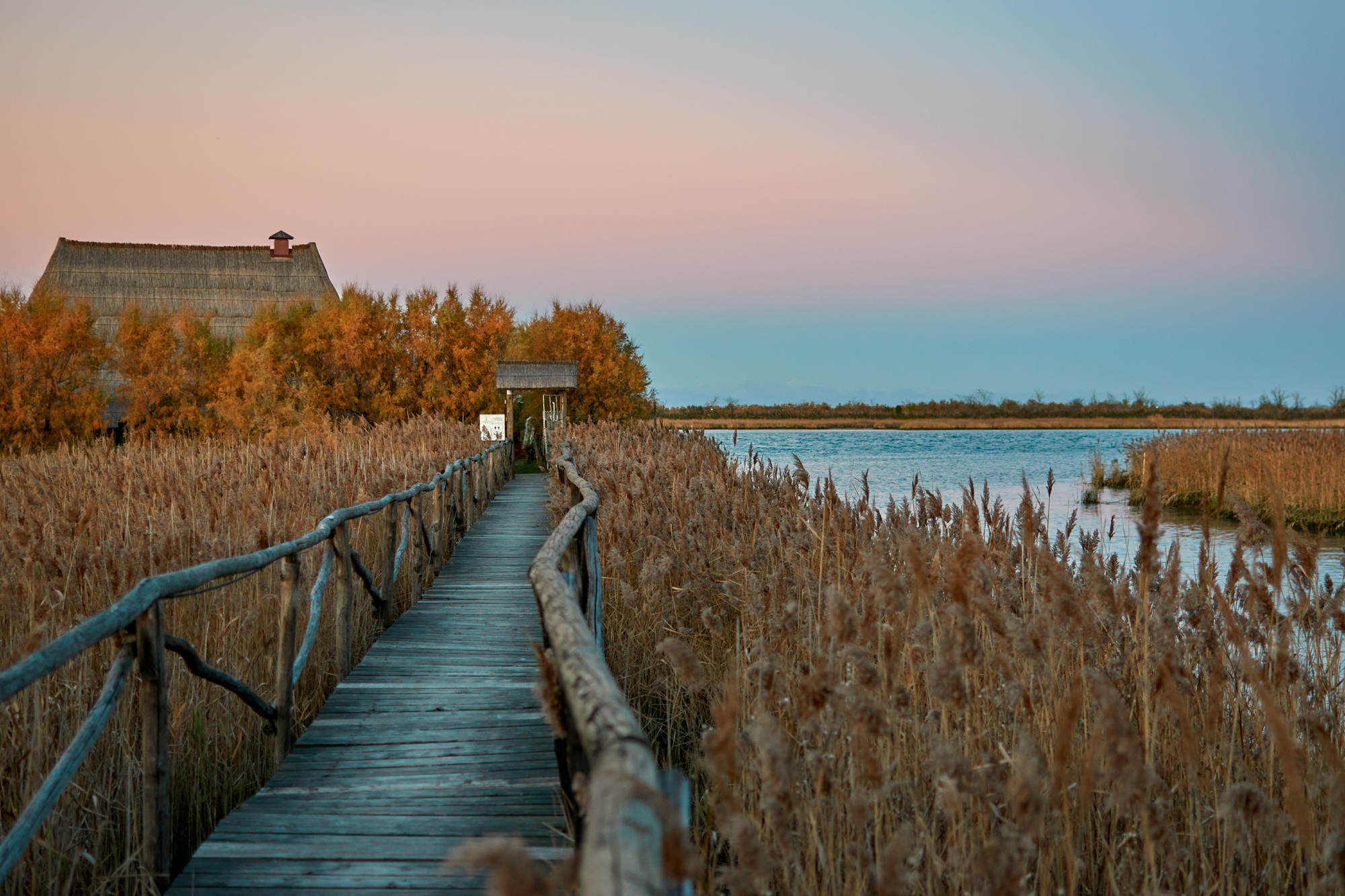
Discovering the Caorle Lagoon
Over the centuries, many casoni were unfortunately destroyed by fires and historical events. Fortunately, several of these traditional dwellings can still be found along the canals and in what is now known as Isola dei Pescatori (Fishermen’s Island).
From the historic centre of Caorle, they are just a few minutes away by bicycle, making this an ideal excursion for anyone who wants to combine nature, cycling and local history.
Today, the casoni are mainly used for tourism and cultural purposes, allowing visitors to discover the history of the lagoon and its traditional way of life. Some of the huts still have a working kitchen and provide a unique setting for dinners and private celebrations, surrounded by the peaceful landscape and far from the bustle of the town centre.
The Caorle Lagoon is also navigable, and during the summer you can explore it on board a sightseeing boat. Several excursions take visitors through its canals and waterways, with stops at the traditional casoni and other fascinating corners of the lagoon. If you’re staying at a camping village in Caorle or Eraclea Mare, ask the information office about the available excursions and set off to discover one of the most fascinating natural landscapes on the Adriatic coast.
Isola dei Pescatori and the Casoni
If you prefer to explore independently, we’ve put together a cycling itinerary that can also be enjoyed on foot.
Starting point: the swing bridge at the entrance to Caorle, or Caorle town centre
Highlights: Isola dei Pescatori, Falconera, swing bridge
Distance: 8.8 km
This is a circular route, so you can join it at any of the suggested points.
If you’re coming from Lido Altanea, you can start at the swing bridge at the entrance to Caorle, on Strada Nuova. Once across the bridge, take the first road on the left, Strada Palangon, which runs alongside the Saetta Canal.
Continue along the road and, after a few hundred metres, the paved surface gives way to a gravel track. Little by little, the urban landscape fades away and the countryside begins to unfold around you.
Just before the sharp 90-degree bend to the right, we recommend stopping for a break. You’ve arrived at Isola dei Pescatori. Here, a pedestrian path leads towards the traditional casoni. The first one you will encounter is the Casone Originale, which can also be visited inside free of charge, thanks to the kind permission of its owners.
Continue along the path to discover other traditional huts, which can be admired from the outside. Take your time, enjoy the peaceful surroundings and admire the beautiful views across the Caorle Lagoon.
The Adventure Continues…
Once you’ve finished exploring the island, get back on your bicycle and continue along the route. After the bend, follow Via dei Casoni, a small country road running alongside the Nicesolo Canal and offering beautiful views across the Caorle Lagoon.
As you cycle through the open countryside, you’ll enjoy the peaceful rural landscape and spot other traditional casoni scattered along the route. After approximately 1.4 kilometres, you will reach Falconera, a more developed area with several restaurants and campsites.
The return journey to Caorle follows paved roads open to traffic. Continue along Viale dei Cacciatori for around 800 metres and then take Viale Falconera. From here, you can make your way back towards the town centre and, after just over 2 kilometres, you will arrive once again at the swing bridge, where your journey began.
This cycling route is not particularly demanding and, with due care on roads open to traffic, it can also be suitable for families with children. You don’t necessarily need a mountain bike: the short gravel sections can be tackled without difficulty on a standard city bike.
Are you passionate about cycling and exploring the area on two wheels? Then don’t miss our other itineraries: along the Livenza River, the cycling route from Caorle to Bibione and through the Venice Lagoon and Lio Piccolo.


